
 Posted by
 Learn about cover types, premiums, excess, and how to choose the right motorcycle insurance policy. I bought my first motorcycle on a Tuesday afternoon in early spring, and by Wednesday, I was sitting in an insurance broker’s office with absolutely no idea what I was doing.
The agent kept throwing terms at me: third-party liability, comprehensive motorbike insurance, excess amounts, and no-claims discounts, and I just nodded along as I understood. I did not. It took me an embarrassing amount of time to actually figure out how motorcycle insurance works, and honestly, I wish someone had just sat me down and explained it plainly from the start.
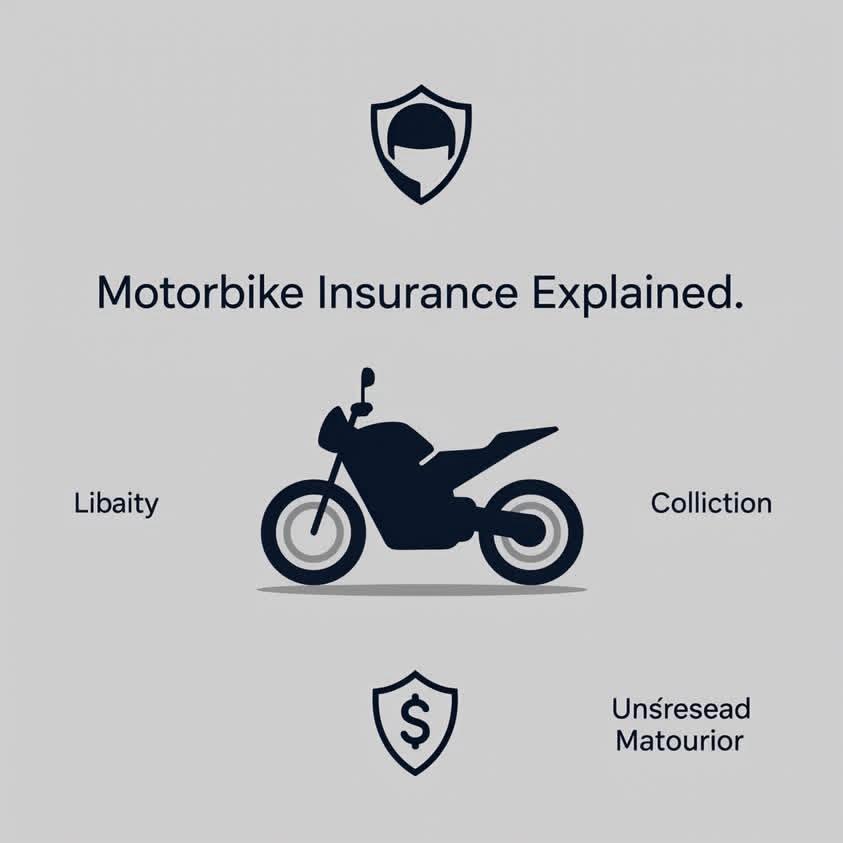
Motorbike insurance is, at its most basic level, a legal requirement in most countries. You cannot ride on public roads without at least a minimum level of motorcycle insurance coverage in place. That minimum is usually third-party insurance, which covers damage or injury you cause to other people and their property. It does not cover your own bike or your own medical bills, which is something a lot of new riders do not fully appreciate until they need to make a claim. I learned that lesson the hard way after a low-speed tip-over in a car park left a decent dent in my tank and nothing but silence from my insurer.
Beyond the basics, there are a few different levels of motorbike insurance cover worth understanding. Third-party fire and theft adds protection if your bike is stolen or damaged in a fire, which might sound like a niche concern but becomes very relevant when you start parking overnight in unfamiliar places. Comprehensive motorcycle insurance is the broadest option and covers damage to your own bike as well, regardless of fault. For newer or more expensive bikes, comprehensive cover is almost always worth the extra premium. The price difference is often smaller than people expect, especially if you have a solid riding history.
Speaking of premiums, motorcycle insurance costs vary enormously depending on a range of factors. Your age, riding experience, the engine size of your bike, where you live, and how you store the vehicle all feed into the calculation. A 19-year-old on a 600cc sports bike in a major city is going to pay considerably more than a 45-year-old commuter with 20 years of clean riding behind them.
That is just the reality of how risk is assessed in the insurance industry. What you can do is work with those variables: completing an advanced riding course, installing a tracker, garaging your bike overnight, and building up your no-claims bonus over time can all meaningfully reduce your annual motorbike insurance premium.
One thing I wish I had paid more attention to early on was the excess. Every motorbike insurance policy has a compulsory excess, the amount you must contribute toward any claim, and most also allow you to add a voluntary excess on top in exchange for a lower premium. It sounds appealing in theory, but if you set that voluntary excess too high and then need to claim, the out-of-pocket cost can sting. I once saved about forty dollars a year by agreeing to a high voluntary excess, then spent weeks regretting it after a minor collision. The math does not always work in your favour.
There is also the question of what your motorcycle insurance policy actually covers in terms of use. Most standard policies cover social, domestic, and pleasure use. If you ride to work, you need to make sure commuting is included. If you deliver food or parcels, that is a commercial use classification entirely, and a standard personal policy will not cover it. Riding uninsured, even accidentally, even because you forgot to update your policy to reflect a change in how you use the bike, can result in fines, licence points, and the kind of financial exposure that makes the cost of proper cover look very small indeed.
Pillion passengers are another consideration that often gets overlooked. Not all motorcycle insurance policies automatically cover a passenger, and if yours does not, riding with someone on the back could invalidate your coverage entirely. Worth checking before you offer anyone a lift. The same goes for modifications, aftermarket exhausts, custom bodywork, and performance upgrades. If you modify your bike and fail to declare it, your insurer may reduce or refuse a payout when you claim. Transparency is genuinely in your interest here, even when it feels inconvenient.
Reference
Abraham, K. S., & Schwarcz, D. (2020). Insurance law and regulation: Cases and materials (7th ed.). Foundation Press.
Aron, J., & Muellbauer, J. (2016). Modelling and forecasting mortality in the United Kingdom. Economic Modelling, 52, 182–201. https://doi.org/10.1016/j.econmod.2014.11.010
Cather, D. A. (2010). A gentle introduction to risk aversion and utility theory. Risk Management and Insurance Review, 13(1), 127–145. https://doi.org/10.1111/j.1540-6296.2010.01173.x