
 Posted by
 Discover how agricultural insurance protects farmers from crop failure, livestock loss, and climate risk, while keeping food supply chains stable and secure. I grew up around people who talked about the weather the way other folks talk about the stock market, checking it constantly and sometimes cursing at the sky when a hailstorm rolled in at exactly the wrong moment. My uncle farmed soybeans for almost thirty years, and I remember one August when a freak storm flattened half his field two weeks before harvest. He did not have agricultural insurance at the time, and watching him try to recover financially from that season taught me more about risk management than any textbook ever could. That memory is probably why I get a little animated when the topic of farm insurance comes up now.
So what exactly is agricultural insurance, and why does it matter so much to the people who grow our food? At its core, agricultural insurance is a way for farmers and ranchers to transfer some of the financial risk tied to crop failure, livestock loss, or equipment damage onto an insurance provider. Instead of absorbing the full blow of a drought or a disease outbreak among cattle, the farmer pays a premium and, in exchange, gets a safety net when things go sideways. It sounds simple when you put it that way, but the actual mechanics behind crop insurance and farm insurance policies can get fairly detailed, involving yield history, regional risk data, and sometimes government subsidized programs, depending on where you live.
I think one reason agricultural insurance does not get talked about enough is that farming still carries this old image of self-reliance, the idea that a good farmer just knows how to read the land and does not need a financial cushion. And honestly, is that not a nice story? But nice stories do not pay the bills when a tornado rips through a wheat field or when a sudden frost kills an entire orchard overnight. Crop insurance exists precisely because nature does not care how skilled or hardworking you are, and farmers are left holding the consequences unless they have planned.
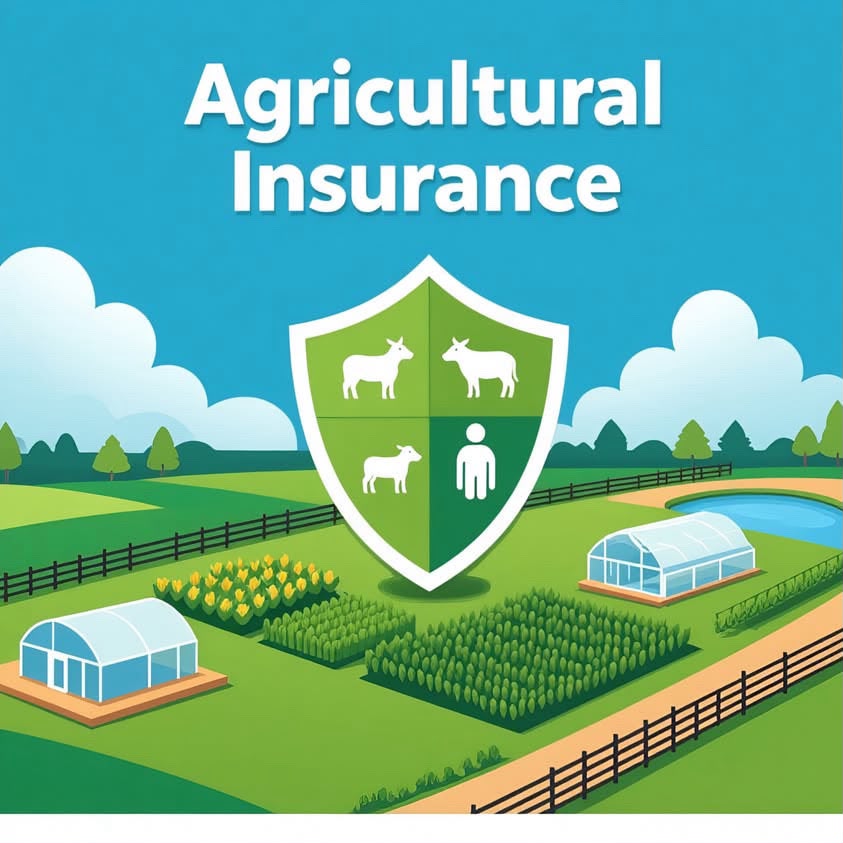
There are a few different types of agricultural insurance coverage worth understanding, though I will not pretend to know every regional variation since insurance rules shift depending on state and country. Broadly speaking, you have crop yield insurance, which protects against lower than expected harvests, and crop revenue insurance, which protects against price drops even if the harvest itself goes fine. Then there is livestock insurance, covering death or illness in herds, and farm property insurance, which behaves a lot like traditional homeowner coverage but applies to barns, silos, and expensive machinery. Each type solves a different problem, and larger farming operations often carry several policies at once just to cover all their bases.
What strikes me most, though, is how agricultural insurance connects directly to food security on a much bigger scale than most people realize. When a farmer loses an entire harvest with no coverage, that loss ripples outward. Prices shift, supply chains tighten, and communities that depend on that farm for income feel the pinch. Insurance is not just protecting one person’s paycheck; it is quietly stabilizing the food system that the rest of us rely on without ever thinking twice about it. I did not fully appreciate that connection until I read into how governments in various countries subsidize crop insurance programs specifically because the ripple effects matter so much economically.
Climate change, unfortunately, is only making this conversation more urgent. Weather patterns that used to be somewhat predictable are becoming erratic, and farmers are dealing with droughts, floods, and unseasonal frosts more frequently than in past decades. Agricultural insurance providers have had to adjust their models constantly to keep pace with these shifting risks, and premiums in some high-risk regions have climbed as a result. It does make me wonder how the whole system will look in another twenty years if these patterns keep intensifying.
For anyone running a farm and trying to decide whether agricultural insurance makes sense for their operation, I would say start by looking closely at your specific risk exposure rather than copying whatever your neighbor has. A dairy operation faces different threats than a vineyard, and a small family farm has different needs than a massive commercial operation spanning thousands of acres. Talking with an agent who understands regional weather patterns and crop-specific risks tends to be far more useful than piecing together a policy from generic online advice, mine included, honestly.
Going back to my uncle for a second, he eventually did get crop insurance a few years after that disastrous storm, and he told me once that it changed how he slept at night during storm season. That stuck with me. Insurance is not just a financial product; it is peace of mind for people whose entire livelihood is tied to something as unpredictable as the weather.
Reference
Economic Research Service, U.S. Department of Agriculture. (2025). Risk management: Crop insurance at a glance. U.S. Department of Agriculture. https://www.ers.usda.gov/topics/farm-practices-management/risk-management/crop-insurance-at-a-glance
Federal Deposit Insurance Corporation. (2024). Agricultural lending, insurance, and implications of climate change. FDIC Center for Financial Research. https://www.fdic.gov/center-financial-research/agricultural-lending-insurance-and-implications-climate-change
Marin, A., & Rusu, T. (2025). The impact of extreme weather events on agricultural insurance in Europe. Agriculture, 15(9), Article 995. https://doi.org/10.3390/agriculture15090995