

 Posted by
 Let me start with a number that kept me up last night. There are roughly 27,000 pieces of tracked debris currently circling Earth. That is just the stuff big enough for us to see from the ground. When you factor in the tiny fragments bolts, paint chips, leftover shrapnel from old explosions we are talking millions. And all of it is moving at speeds around 28,000 kilometers per hour.
To put that in perspective, a fleck of paint at that velocity can crack a spacecraft window like an eggshell. A larger fragment? It can end a billion-dollar mission in a split second. So here is the question that nobody asked twenty years ago but everyone is asking now: who pays when something goes wrong? That is where space debris insurance comes into the picture. And trust me, it is weirder and more complicated than you think.
I remember reading about the 2009 collision between an active Iridium satellite and a dead Russian Kosmos satellite. That single event created about 2,000 new trackable pieces of junk. But here is the part that stuck with me. It also triggered an insurance claim that exposed just how unprepared the entire industry was. We are not talking about a fender bender.
We are talking about high-speed chaos in a vacuum, with no tow trucks and no police reports. You would think there is a clear rulebook by now. There is not. The main legal framework is the 1972 Liability Convention. In theory, it says that if your space object causes damage on Earth, you are absolutely liable. For damage that happens in orbit? You are liable only if someone can prove you were at fault.
Sounds reasonable until you try to trace a random bolt back to a specific country, prove they were negligent, and then navigate a diplomatic insurance claim between governments. Do you want to know how many times that Convention has actually worked? Once. One single time. Canada claimed against the Soviet Union in 1978 after a nuclear-powered satellite called Cosmos 954 scattered radioactive debris across Canadian territory.
That is it. Every other collision or debris event since then has been a legal gray zone. So what do satellite operators do? They turn to private insurers. And honestly, the insurance market has been trying to keep up. Standard policies cover launch failure, in-orbit weirdness, and third-party liability. That last third-party liability is the debris-adjacent piece.
If your satellite causes a collision or blows up and creates new junk, your liability policy is supposed to pay out. Looking up at the night sky, you would never guess that a storm of metal and plastic is racing overhead at 17,000 miles per hour. Space debris insurance has become a hot topic for satellite operators, and honestly, after digging into the numbers, I think it is one of the most overlooked business risks of our time.
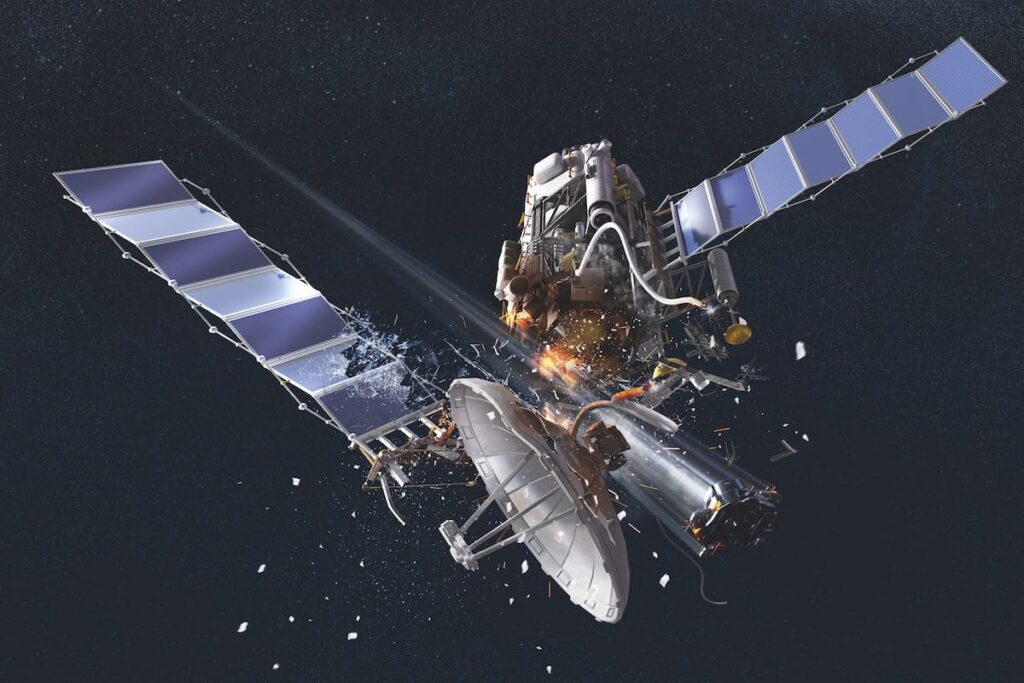
But here is the uncomfortable truth. Coverage limits have not kept pace with the scale of a potential disaster. A major orbital collision could generate damages that exceed what many smaller operators carry. I have talked to people in the industry who admit, off the record, that a really bad day in low Earth orbit could bankrupt multiple companies at once. That is not fearmongering. That is just math.
Now let me introduce a new twist. There are companies out there right now building technology to capture and deorbit old satellites. They call it active debris removal. On the surface, that sounds wonderful. We clean up the mess. Everyone wins.
Except. Who is liable if a removal mission goes wrong? Imagine a capture arm misfires and instead of grabbing one dead satellite, it creates five hundred new fragments. Or imagine a removal vehicle collides with an active satellite owned by another country.
How do you insure an activity that operates in a jurisdiction-ambiguous environment and interacts with objects legally owned by other entities? I am not being rhetorical here. These are actual open items sitting on underwriters’ desks as we speak. Actuaries are building orbital collision probability models that look like something out of a NASA control room. Satellite operators are being asked surprisingly detailed questions about their debris mitigation plans before anyone will issue a policy.
The insurance industry, for all its flaws, tends to price risk honestly because its business model depends on getting those prices right. And space debris is starting to carry a premium. So where does that leave us? The commercial space sector is growing so fast that debris risk has become its own underwriting discipline. I think that is both terrifying and fascinating.
Every new launch adds another object to an already crowded highway. Every old satellite that runs out of fuel becomes a potential missile. And somewhere in the middle, insurance companies are trying to calculate odds that have never been calculated before. If you are a satellite operator, here is my unsolicited advice. Do not assume your standard policy covers a worst-case debris event. Read the fine print.
Ask about third-party liability limits. And maybe say a small prayer before every orbital maneuver. Because that fleck of paint moving at 28,000 kilometers per hour? It does not care whose satellite it hits. It only cares about physics. And physics, unlike insurance, never negotiates. For more on the 2009 Iridium-Kosmos collision and its legal aftermath, check out this detailed report from the Secure World Foundation: Space Debris and Insurance
References
United Nations Office for Outer Space Affairs. (1972). Convention on international liability for damage caused by space objects.
UNOOSA (treaty intro): https://www.unoosa.org/oosa/en/ourwork/spacelaw/treaties/introliability-convention.html
NASA Orbital Debris Program Office. Orbital debris quarterly news.
Weeden, B. (2012). 2009 Iridium-Cosmos collision fact sheet. Secure World Foundation.
European Space Agency. ESA’s space debris office