
 Posted by
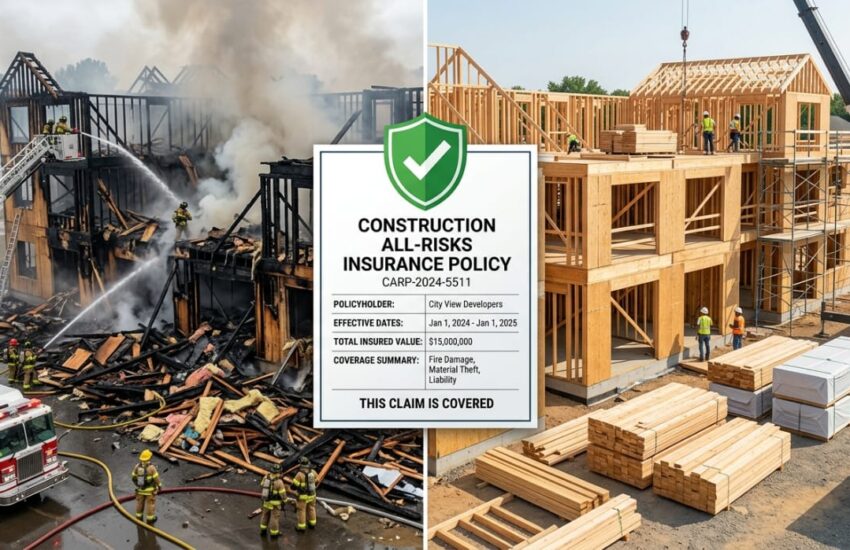
 The morning the fire started, I was at work, blissfully unaware that my dream renovation was about to become a nightmare. A spark from a welding torch had ignited some drywall dust, and within minutes, the framing I had just paid for was charred and smoking. The general contractor called me with the news, his voice tight with stress. My first question was, “Is everyone okay?” My second was, “Who pays for this?” That was the moment I learned about builder’s risk insurance, the hard way.
Builder’s risk insurance is a specialized type of property insurance that covers buildings and structures during the course of new construction, renovation, or repair . It is designed to protect the financial investment in a project while it is still in progress, covering materials, labor, and sometimes even the existing structure itself . If a fire, theft, or severe weather event damages the project before it is completed, the policy helps cover the cost of repairs or replacement .
The first thing I learned is that a standard homeowner’s insurance policy does not cover a home under renovation. Most homeowner policies contain a vacancy exclusion if a home is vacant for more than 60 days . Even if you are living in the home during the renovation, the policy may not cover certain construction-related risks. Builder’s risk insurance is not just a good idea; it is often required by lenders, and most experienced contractors will not start a project without it in place .
So, what exactly does builder’s risk insurance cover? The core coverage is physical loss or damage to the structure itself. This includes materials and supplies that are at the job site, in transit, or temporarily stored off-site . It also covers the cost of labor and, in some cases, the contractor’s lost profits if a covered loss delays the project . Depending on the policy, it can also protect temporary structures like scaffolding, fencing, and falsework, and it covers the cost of debris removal after a covered loss . Some policies even extend to cover property owned by others that is on the site, such as materials supplied by subcontractors .
One of the most important decisions is who buys the policy. The contractor can buy it, or you can buy it yourself, but either way, you typically pay for it . If the contractor buys the policy, make sure your name is added as an “additional named insured” so you have direct coverage and are notified if the policy lapses . If you purchase it yourself, you will need to provide the insurer with an estimate of the total completed value of the project .
This leads to a crucial distinction: builder’s risk insurance is not the same as general liability insurance. Many people assume they are interchangeable, but they cover fundamentally different risks . General liability insurance protects you if someone is injured on the job site or if you accidentally damage someone else’s property . Builder’s risk insurance protects the physical structure and materials themselves . You need both. One protects you from lawsuits; the other protects your investment from physical loss.
I also learned that not all projects are eligible for builder’s risk insurance. Some insurers will not cover mobile homes, structures built over water, or registered historical structures that require historical society approval . The cost of the policy depends on the scope of the project, its total value, the location, and the builder’s experience. A standard deductible is often around $1,000, and there is usually a minimum premium .
One of the biggest mistakes I almost made was assuming the policy would cover everything. Many policies exclude damage from earthquakes, flooding, and hurricanes . If you are building in an area prone to these risks, you may need to purchase separate endorsements or add-ons for full protection. It is also important to note that the policy has a specific term, usually six, nine, or twelve months, and it ends when the project is completed, the building is occupied, or the policy expires . If your project runs long, you need to extend the policy before it expires, or you will have a gap in coverage.
After my fire, I was grateful for the insurance. The claim was processed, the damaged framing was replaced, and the project continued. But the experience taught me a valuable lesson: builder’s risk insurance is not a luxury. It is a necessity. It is the shield that protects your investment from the unexpected, so you can focus on bringing your vision to life.
There is so much more to learn about protecting your construction project. Our website is filled with articles on insurance, risk management, and home renovation. Head over and explore, because the best projects are the ones that are fully protected.
References
US Assure. (2022, November 21). *What is builders risk insurance*. https://usassure.com/resources/articles/what-does-builders-risk-insurance-cover
The Hartford. (2026, June 23). *What is builder’s risk insurance?* https://www.thehartford.com/insights/construction/builders-risk-insurance
Nationwide. (2026, June 11). *Get builder’s risk insurance*. https://www.nationwide.com/business/insurance/builders-risk/
State Farm. (n.d.). *Builder’s risk insurance*. https://www.statefarm.com/insurance/small-business/business-owners-policy/builder-risk
Chubb. (n.d.). *Builders risk insurance*. https://www.chubb.com/us-en/business-insurance/builders-risk-insurance.html