
 Posted by
 Here is what I learned about income protection, elimination periods, and picking the right policy for you. I never thought much about long-term disability insurance until a friend of mine, a contractor who could practically build a house with his eyes closed, fell off a ladder and tore something in his back that never quite healed right. He was out of work for almost a year.
Not a few weeks, not a couple of months, a full year. And watching him scramble to cover rent while his savings drained away taught me something that no insurance brochure ever could, which is that income protection is not some abstract financial product reserved for people who are already wealthy enough to plan. It is for anyone who depends on a paycheck, which, last I checked, includes almost everybody I know.
Long-term disability insurance, often shortened to LTD insurance, is coverage designed to replace a portion of your income if an illness or injury keeps you from working for an extended period of time. I say extended because that distinction matters quite a bit. Short-term disability insurance usually covers you for a handful of weeks or a few months, but long-term disability insurance picks up where that leaves off and can stretch on for years, sometimes until retirement age, depending on how the policy is written.
There is typically a waiting period, also called an elimination period, before benefits kick in, and mine, for instance, runs about ninety days. Why does that matter? Because if you do not have savings or short-term coverage to bridge that gap, those three months can feel like an eternity.
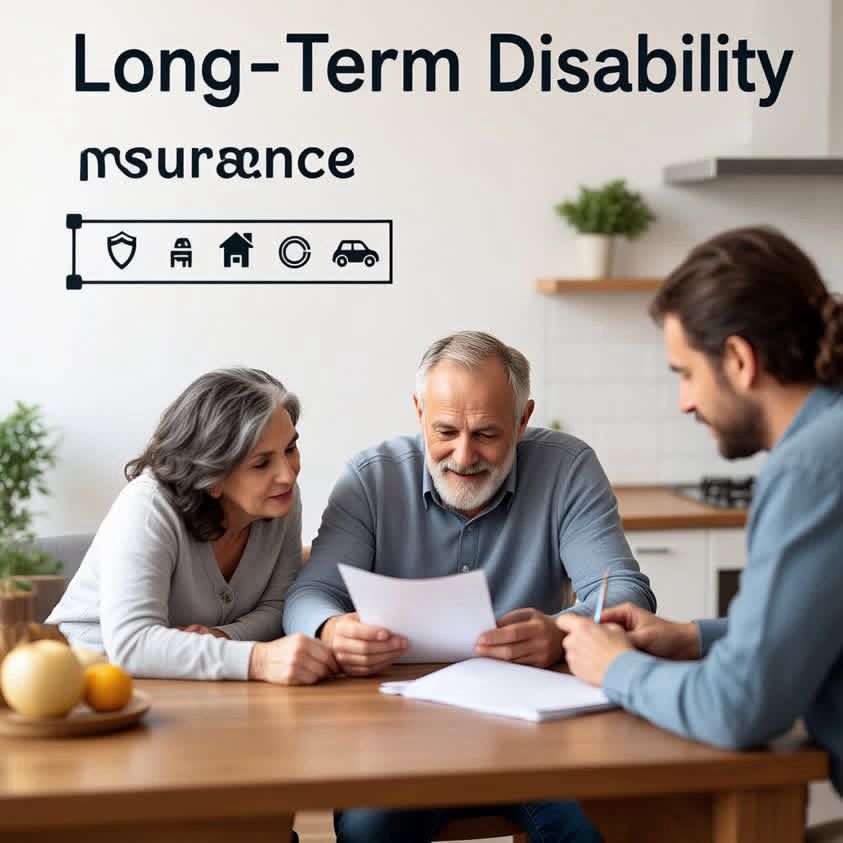
I remember sitting down with an insurance agent a few years back, somewhat reluctantly, I will admit, because talking about the possibility of becoming disabled is not exactly a fun way to spend a Tuesday afternoon. She walked me through the difference between a group disability insurance plan, the kind many employers offer as part of a benefits package, and an individual disability policy that you purchase on your own.
Group coverage tends to be cheaper and easier to get without a medical exam, but it usually comes with lower benefit caps, and the coverage disappears the moment you leave your job. An individual policy follows you wherever your career goes, which felt important to me once I started freelancing and realized nobody was going to hand me a benefits package ever again. Premiums for an individual disability policy also depend heavily on your occupation and health history, so a desk job and a roofing job are not priced the same way, and that makes sense once you think about it.
Have you ever tried to imagine living on sixty percent of your normal income for years at a time? I had not, not really, until I ran the numbers myself. Most long-term disability policies replace somewhere between fifty and seventy percent of your pre-disability earnings, and at first, that sounded reasonable enough, almost generous even. Then I started subtracting my mortgage, my car payment, and the absurd cost of groceries these days, and the math got uncomfortable rather quickly. That exercise alone convinced me that the benefit percentage written into a policy is not just a number to skim past. It is the number that decides whether you keep your house or sell it.
One detail that caught me off guard, and that I think gets overlooked constantly, is the definition of disability written into the fine print. Some policies use their own occupation standard, meaning you qualify for benefits if you cannot perform the specific job you had before.
Others switch to an any occupation standard after a couple of years, which means the insurer can stop paying once you are deemed capable of doing some job, any job, even if it pays a fraction of what you used to earn. My friend, the contractor, learned this the hard way. His policy shifted definitions after twenty-four months, and suddenly, he was expected to find work he was, frankly, not built for anymore.
Reference
Luznar, Ӧ., & Costa, J. (2019). The prevalence of employer-provided benefits by industry of employment and implications for Social Security Disability Insurance claiming behavior. Social Security Bulletin, 79(1). https://www.ssa.gov/policy/docs/ssb/v79n1/v79n1p47.html
Monaco, K. (2015). Disability insurance plans: Trends in employee access and employer costs. Beyond the Numbers: Pay & Benefits, 4(4). U.S. Bureau of Labor Statistics. https://www.bls.gov/opub/btn/volume-4/disability-insurance-plans.htm
Social Security Administration. (2025). Annual statistical report on the Social Security Disability Insurance program, 2024. https://www.ssa.gov/policy/docs/statcomps/di_asr/index.html